To the U.S. and the Soviets, Afghanistan has always been a pawn in a much bigger game. Both countries have used Afghanistan for their own gain since the late 1970’s. The Soviet Union invaded Afghanistan in December 1979. A peace agreement between the two countries wasn’t signed until February 1989, when Afghanistan defeated the Soviet Union. Infighting between Mujahideen, an Afghan guerrilla movement (originally formed in 1978), and Najibullah's regime continued throughout this period, until 1992 when the Mujahideen took Kabul and liberated Afghanistan. Najibullah was protected by UN. The Mujahideen formed an Islamic State and Professor Burhannudin Rabbani was elected President.
In 1994 the Taliban militia were born and advanced rapidly against the Rabbani government. In 1995 massive gains were made by the Taliban and in the following year the Taliban militia forced President Rabbani and his government out of Kabul. After that they captured Kabul and executed Najibullah. The Taliban oppressed women, forced men to grow beards and ‘Buzkashi’ the Afghan national sport was outlawed. Tensions rose as the Afghan government accused Pakistan of aiding the Taliban. The Taliban massacred thousands of innocent civilians.
In 1998 the United States launched cruise missiles at Afghanistan, stating that its intent was to destroy the so called terrorist bases/training facilities used by Osama Bin Laden and his followers. In 1999 and 2000 the UN Security Council Resolutions 1267 and 1333 were adopted. These resolutions used sanctions against the Taliban on grounds that they offered sanctuary to Osama Bin Ladin and for their continued support of terrorism and the cultivation of drugs.
During 2001 the Taliban continued to torture and kill civilians and destroy ancient historical sites. The world expressed outrage and disgust against the Taliban actions. On September 11th 2001 suicide attacks on the U.S. killed more than 3,000 people and destroying the World Trade Centre and part of the Pentagon. Following these attacks the United States and UK worked with the forces of the United Front (UNIFSA) to launch air strikes against the Taliban. The U.S. held Osama Bin Laden directly responsible for the attacks on the World Trade Centre, and the Taliban were targeted for protecting him.
Wednesday, January 13, 2010
Taliban History Lesson


January 13th Morning Readbook

U.S. Agriculture Secretary Tom Vilsack (C) discusses potato and onion prices with a vendor (L) in a bazaar in Nawa, Helmand province, January 11, 2010. Vilsack is in Afghanistan on a three-day visit to assess how to rebuild its agriculture sector. Picture take January 11, 2010. REUTERS/Sue Pleming
Generals should be guided by truth, not politics
In his Dec. 27 column, ["An admiral who found the center," op-ed], David Ignatius distorts the proper role of the chairman of the Joint Chiefs of Staff. He glosses over Adm. Mike Mullen's professional failures, particularly on Afghanistan and his handling of the firing of Gen. David McKiernan.
3,100 more troops on Afghanistan deployment list
The troops, most from the 4th Combat Aviation Brigade at Ft. Hood, Texas, will deploy this summer. The Pentagon has now issued orders to 25,000 of the 30,000 additional troops bound for Afghanistan.
U.S. official promises expanded oversight in Afghanistan
President Obama's special inspector general for Afghanistan said in Kabul on Tuesday that his team is boosting its staffing as U.S. aid money into the country grows -- along with the potential for fraud and abuse.
U.S. uses Predator drone to hit suspected insurgents in Afghanistan; 13 killed
Using a Predator drone, the U.S. military this week fired a Hellfire missile into a crowd of suspected insurgents in Helmand province, killing 13 people and wounding three, military officials said Tuesday. It was one of two such attacks by unmanned aircraft on the same day.
Afghan villagers protest 'Nato killings'
Yemen al-Qaeda link to Guantanamo Bay prison
The failed Detroit airliner bomb attack on Christmas Day awakened the world to the threat from al-Qaeda in the Arabian Peninsula (AQAP), a group that until then was hardly a household name.
Reports: Al Qaeda leader killed in Yemen
The leader of an al Qaeda cell in Yemen has been killed in clashes with security forces, the Yemeni government said Wednesday. Abdullah al-Mehdarhad, whose name is also spelled as al-Mihdar, led a cell in the Habban region of Yemen's Shabwa province, according to 26sep.net, the Web site for the Yemeni military.
New evidence of Qaeda tie to Madrid blast: expert
The 2004 Madrid bombings, Europe's deadliest Islamist militant attack, probably were instigated by al Qaeda and were not the work of autonomous cells, a top terrorism expert says.
Iraq forces detain 25 suspects, seize explosives in Baghdad
Qassim Atta, spokesman for Baghdad Operations Command, said in a statement that his troops confiscated 200 kg of C4 explosives, 200 kg of TNT, 60 mortar rounds and some 250 litre of ammonium nitrate which is used for making bombs during the search operations conducted early Tuesday morning.
Iraq security measures set off rumors of coup
Baghdad says it ordered a virtual lockdown to foil a plot involving car bombs and suicide attacks. The ensuing panic paints a picture of a jittery city bracing for elections.
The latest news from Al Jazeera
Tuesday, January 12, 2010
The Man Wrecking Iraqi Reconciliation

Ali Faisal al-Lami, accused of being a member of Asa'ib Ahl al Haq and of masterminding a bombing that killed 10 people, was among those recently released from United States custody. Mr. al-Lami denies both charges. (Johan Spanner for The New York Times)
Ali Faisal al-Lami, an admitted supporter of the Iranian-supported Leagues of the Righteous, is the man behind the attempted barring of Saleh al-Mutlaq from the upcoming election. In August last year, the New York Times profiled the reconciliation of the Shiite insurgents and some of the detainees being released.
Among those released recently was Ali Faisal al-Lami, the former director general of Iraq’s de-Baathification council. The military held him for nearly a year after accusing him of organizing a bombing that killed two American Embassy employees, two American soldiers and six Iraqis at a district council meeting in Baghdad last year.Lami's attempt to block a well-known Sunni politician confirm the suspicions of a disenfranchised Sunni population; that the new Iraqi government is deeply sectarian and serving an Iranian agenda. The fact that someone with Lami's recent history can return to such a high-level position speaks volumes to the Iraqi government's current state. Within the past week, Lami commented to the press on the Leagues' recently released leader Qais Khazali.
“The Americans are leaving Iraq defeated,” Mr. Lami said in an interview on Monday, three days after his release from Camp Cropper near Baghdad International Airport, where so-called high-value detainees are held. “Everything they are doing right now is to save face.”
Mr. Lami said his release was part of a government deal with the League, though he described himself as a “supporter” of the group rather than a member.
"Qais has already given great service to Iraq, first as someone who served the resistance and then as someone who helped placed pressure on the occupiers to commit to the withdrawal of foreign forces," said senior Shia figure Ali Faisal al-Lami, who is closely aligned to the Righteous League. "He was already politically involved when he was spokesman for Muqtadr al-Sadr and he will resume a political role even if it is not as part of the government."Today, a "former" insurgent is using his position in the government to push alleged Baathists out of the government. With Maliki and Lami sharing a similar Baath paranoia, it is no wonder Lami is back in his old position during this critical period before parliamentary elections. The LA Times noted that this Iranian proxy and sectarian actor was behind the attempt to bar Mutlaq.
In 2008 Lami was suspected of links to Moore's kidnapping and spent 18 months in American detention, where he was interrogated by an MI6 officer who was leading the government's efforts to find the IT consultant and his four guards. In prison he spoke regularly to Khazali, along with Khazali's brother Laith and a third man, Lebanese Hezbollah member Ali Mahmoud al-Dakduk. The three were captured by the SAS in March 2007. Moore and his guards were kidnapped two months later, partly to be used as pawns for the trio's release.
The Justice and Accountability Committee charged with checking that candidates don't have ties to Baathists has named Saleh Mutlak, a prominent lawmaker, among those disqualified from the elections, according to the panel's executive director, Ali Lami.Only time will tell if the Justice and Accountability Committee's recommendations will be approved. For more on the Leagues of the Righteous and their reconciliation with the Iraqi government, read LongWarJournal's Bill Roggio's article "A Terrorist Goes Free: Apparently we do negotiate with hostage-takers."
That means that Mutlak's Iraqi Dialogue Front also will be barred, said Lami, who was detained by the U.S. military for a year on suspicion of ties to Iranian-backed militias.
January 12th Morning Readbook

US Afghan buildup 'showing success'
The top US commander in Afghanistan says he believes a recent US troop buildup in the country has started to turn the tide against the Taliban. In an interview with ABC television on Monday, General Stanley McChrystal said the decision by Barack Obama, the US president, to increase American troop numbers in the country has "changed the way we operate in Afghanistan".
U.S. general: Taliban beaten in Helmand province
U.S. forces have driven the Taliban from most towns and villages in the strategic Helmand province of Afghanistan, leaving incoming troops with the mission of holding key areas and rebuilding the economy, Marine commanders say. "They've taken on the Taliban, the insurgency, right in the heartland and they've defeated them," said Marine Maj. Gen. Richard Mills in an interview with USA TODAY.
Pakistan suffers record number of deaths due to militant violence
A record number of Pakistani civilians and security forces died in militant violence last year as the country reeled from an onslaught of Taliban suicide bombings that propelled it into the ranks of the world's most perilous places.
Report: 20 percent of released detainees returning to terrorism
A classified report by the Pentagon's Defense Intelligence Agency (DIA) says that one in five former detainees returned or are suspected to have returned to terrorist activity after leaving the U.S. prison facility. That is an increase from 14 percent from a similar report by the DIA released in April, according to the official familiar with the new report.
2 Navy SEAL cases moved to Iraq
Two of three Navy SEALs accused in the alleged assault of an Iraqi suspected of orchestrating the 2004 killing and mutilation of four U.S. contractors in Falluja will have their cases heard in Iraq, a judge ruled Monday.
Security an issue for post-election Iraq
The next government of Iraq must create divisions between politics and national security mechanisms, a deputy prime minister said in Baghdad. Iraqis head to the polls in March to pick a new government. Iraqi Prime Minister Nouri al-Maliki is expected to ride on a national security platform in a bid to secure a second term in office.
Somalis fleeing to Yemen prompt new worries in fight against al-Qaeda
Thousands of Somali boys and teenagers fleeing war and chaos at home are sailing to Yemen, where officials who have long welcomed Somali refugees now worry that the new arrivals could become the next generation of al-Qaeda fighters.
The latest news from Al Jazeera
Monday, January 11, 2010
Iraq: 2005 Election Redux

Photo courtesy of http://bagnewsnotes.typepad.com
Contrary to popular belief, Sunnis did participate in the December 2005 parliamentary elections. This false notion has been kept alive by comments from Iraq's top U.S. officer today and faulty press reporting.
DoD News Briefing with Lt. Gen. Odierno from Iraq
January 17, 2008
But number one for me is provincial powers leading then to the laws they need in order to conduct provincial elections because many people -- although we had a great turnout in 2005, Sunnis didn't vote and some Shi'a groups didn't vote.Interview: Gen. Odierno with Fox News, Oct. 13 2008
Well, I think so. I mean, the Iraqis are, are really thrilled with elections. We're going to have this is a big year. 2009 is a big year. They're going to have provincial elections in January of 2009, followed at the end of 2009 by national elections. And I think this will be important. The second set of elections actually are more important than the first because it proves that they're serious about having elected officials run their government.Interview: Gen. Odierno with John Hendren from ABC News, Oct. 10 2008
I would just say what’s encouraging is the fact they are using the political process. These are very difficult issues. The fact that they have passed the provincial election law—the election probably will occur on the 31st of January. That’s an extremely positive step. So although we would have liked to have had it in 2008, it’s very early in 2009. It will allow the people to elect those that are representative of them which was not always the case after the 2005 elections. We believe everybody will participate. We believe that, in itself, will improve the stability over time.Sunnis did in fact vote although participating in an election did not "improve the stability over time." Former Multinational Forces - Iraq Commander General George Casey, the commanding officer later relieved by General Petraeus, was very positive over Sunni participation in the December 2005 parliamentary elections.
Sunni Turnout Substantial in Iraq Voting, Casey Says
Dec. 15, 2005
Sunni voter turnout in today's Iraqi election appeared much greater than it was during the Oct. 15 constitutional referendum, the top U.S. military officer in Iraq said today.
News coverage of long lines of Iraqis waiting to cast their ballots across Iraq today already indicated a higher overall turnout than during the Oct. 15 constitutional referendum, Army Gen. George W. Casey Jr., commander of Multinational Force Iraq, said during a live satellite broadcast appearance during today's Pentagon "town hall" meeting.
"We should expect the insurgency not to just go away because there were great elections today," Casey said. However, he expected the insurgency in Iraq to be gradually reduced over time as its root causes are addressed.
Democratic nations in the West were guilty of cultural projection during the lead-up to the December 2005 elections.
Sunnis Will Not Boycott Important Voting Again
August 28th, 2005
It looks like the Sunnis have learnt their lesson from being stubborn seven months ago. They had the chance to participate in the now so heavily debated constitutional draft if they had not decided to boycott the elections in the beginning of this year. This mistake has been costly and they seem to finally realize this and intend not to make the same mistake again.Iraqis flock to polls as insurgents urge Sunnis to vote
Early estimates suggested more than 70% of the 15 million voters turned out, with participation strong in Sunni areas that have previously shunned the nascent democratic process.Today, the Iraqi government that formed after the December 2005 election is attempting to ban Saleh al-Mutlaq from the 2010 election due alleged ties to the banned Baath Party of Saddam Hussein. The New York Times was also guilty of propagating the boycott myth as recently as several days ago.
In Ramadi, a centre of armed resistance to the US occupation, masked gunmen guarded polling stations in Ramadi. "The mujahedin were at the polling station urging us not to let our voice be split. They urged us to go for either of the two Sunni lists, the Consensus Front or Saleh al-Mutlaq," said Ali Abed al-Dulaimi, a retired car salesman, in a telephone interview. Both lists, one Islamist, one secular, claim to have links with the nationalist gunmen.
Sunnis largely boycotted the 2005 elections, handing Shiite Muslims and Kurds disproportionate power in the National Assembly. Mr. Mutlaq’s absence from the March 7 vote could prompt another boycott by some Sunnis, this time during a critical period for the American military here as it moves ahead with plans to withdraw all combat troops from Iraq by year’s end.The final word comes from Robin Wright from December 16, 2005 in the Washington Post.
For President Bush, the strong turnout for Iraq's election yesterday may represent the best day since the fall of Baghdad 32 months ago because all major factions participated in the political process, according to U.S. and Middle East analysts. But the sobering reality, they added, is that the vote by itself did not resolve Iraq's lingering political disputes.
January 11th Morning Readbook
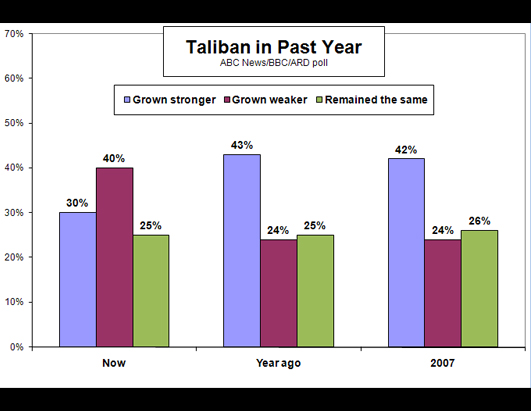
Views Improve Sharply in Afghanistan, Though Criticisms of the U.S. Stay High
Hopes for a brighter future have soared in Afghanistan, bolstered by a broad rally in support for the country's re-elected president, improved development efforts and economic gains. Blame on the United States and NATO for violence has eased – but their overall ratings remain weak. In one key shift, the latest poll by ABC News, the BBC and ARD German TV finds that sharply more Afghans now see the Taliban as the main source of their country's strife, while many fewer blame the United States or its allies – significant progress in a central aim of the new commander of U.S. and NATO forces, Gen. Stanley McChrystal.
ABC News/BBC/ARD Afghanistan Poll – Note on Methodology
This survey was conducted for ABC News, the BBC and ARD by the Afghan Center for Socio-Economic and Opinion Research (ACSOR) in Kabul, a subsidiary of D3 Systems Inc. in Vienna, VA, USA. Interviews were conducted in person, in Dari or Pashto, among a random national sample of 1,534 Afghan adults Dec. 11-23, 2009.
Senator: Pakistan army may go to North Waziristan
A senator who's just visited Pakistan says Pakistan's military may be considering a move into the militant stronghold of North Waziristan.
Privatized War, and Its Price
A federal judge in Washington, Ricardo Urbina, has provided another compelling argument against the outsourcing of war to gunslingers from the private sector. In throwing out charges against Blackwater agents who killed 17 Iraqis in Baghdad’s Nisour Square in September 2007, Judge Urbina highlighted the government’s inability to hold mercenaries accountable for crimes they commit.
Iraq hostage Peter Moore tells Met Police of capture
The IT expert from Lincoln's account of his capture in Iraq in 2007 is likely to be crucial to inquiries into the murder of three of his bodyguards.
Yemen’s President Says Government Is Willing to Talk to Disarmed Qaeda Fighters
Yemen’s government is “determined to stand up to the challenges” of Al Qaeda, but will be willing to talk to any Qaeda follower who “renounces violence and terrorism,” said the country’s president, Ali Abdullah Saleh, in an interview broadcast late Saturday night.
Petraeus Rules Out Sending U.S. Troops to Yemen
Gen. David Petraeus, head of U.S. Central Command, ruled out sending U.S. troops to Yemen, where the al Qaeda affiliate that has claimed responsibility for the attempted Christmas Day airline bombing is based.
The latest news from Al Jazeera
Sunday, January 10, 2010
January 8th - 10th Weekend Readbook
Mehsud's death sparked CIA attack
Bomber's betrayal shows spy challenge for West
The killing of CIA employees in Afghanistan by a suicide bomber lauded online as a militant James Bond suggests al Qaeda's south Asian allies have developed an unprecedented capacity to disrupt the West's spy efforts.
Tributes to British war reporter killed working with US troops in Afghanistan
A British journalist has been killed in an explosion while covering the war in Afghanistan. Rupert Hamer, 39, the defence correspondent of the Sunday Mirror newspaper, was with the US Marines in Helmand province when he was killed by a roadside bomb.
Afghans Losing Hope After 8 Years of War
In Kabul, even a traffic jam can provoke a comment on this Islamic nation's dismal state, which most people here believe is at its bleakest since the U.S. invaded to topple the Taliban in 2001. It's a striking sentiment when you consider it comes after eight years of international intervention, $60 billion in foreign aid and the lives of thousands of foreign troops and Afghan civilians.
US drone war delivers results, but at what price?
The US drone war in Pakistan has made gains in annihilating Taliban and Al-Qaeda commanders, but the reliance on the unmanned, remotely controlled aircraft risks fanning Islamist violence.
Yemen sends message to al-Qaeda
Corruption-plagued Iraq joins oil transparency group
Iraq joined a global transparency initiative Sunday in a bid to heal its reputation as a nation plagued by corruption and misuse of its vast oil wealth.
Fate of 15 Iraqi political parties in balance
Iraq's electoral commission will decide within days whether to ban 15 political parties from running in March polls because their leaders allegedly have links to former dictator Saddam Hussein, a spokesman said Saturday.
The latest news from Al Jazeera
Bomber's betrayal shows spy challenge for West
The killing of CIA employees in Afghanistan by a suicide bomber lauded online as a militant James Bond suggests al Qaeda's south Asian allies have developed an unprecedented capacity to disrupt the West's spy efforts.
Tributes to British war reporter killed working with US troops in Afghanistan
A British journalist has been killed in an explosion while covering the war in Afghanistan. Rupert Hamer, 39, the defence correspondent of the Sunday Mirror newspaper, was with the US Marines in Helmand province when he was killed by a roadside bomb.
Afghans Losing Hope After 8 Years of War
In Kabul, even a traffic jam can provoke a comment on this Islamic nation's dismal state, which most people here believe is at its bleakest since the U.S. invaded to topple the Taliban in 2001. It's a striking sentiment when you consider it comes after eight years of international intervention, $60 billion in foreign aid and the lives of thousands of foreign troops and Afghan civilians.
US drone war delivers results, but at what price?
The US drone war in Pakistan has made gains in annihilating Taliban and Al-Qaeda commanders, but the reliance on the unmanned, remotely controlled aircraft risks fanning Islamist violence.
Yemen sends message to al-Qaeda
Corruption-plagued Iraq joins oil transparency group
Iraq joined a global transparency initiative Sunday in a bid to heal its reputation as a nation plagued by corruption and misuse of its vast oil wealth.
Fate of 15 Iraqi political parties in balance
Iraq's electoral commission will decide within days whether to ban 15 political parties from running in March polls because their leaders allegedly have links to former dictator Saddam Hussein, a spokesman said Saturday.
The latest news from Al Jazeera
Thursday, January 7, 2010
Obama and the DNI

I was going through the President's speech on the Christmas attack attempt. Needless to say, it was a bit confusing.
First, I'm directing that our intelligence community immediately begin assigning specific responsibility for investigating all leads on high-priority threats so that these leads are pursued and acted upon aggressively — not just most of the time, but all of the time. We must follow the leads that we get. And we must pursue them until plots are disrupted. And that mean assigning clear lines of responsibility.First, other people will be blamed for failures even though the president stated in the same speech,
Second, I'm directing that intelligence reports, especially those involving potential threats to the United States, be distributed more rapidly and more widely. We can't sit on information that could protect the American people.
Third, I'm directing that we strengthen the analytical process, how our analysis — how our analysts process and integrate the intelligence that they receive. My Director of National Intelligence, Denny Blair, will take the lead in improving our day-to-day efforts. My Intelligence Advisory Board will examine the longer-term challenge of sifting through vast universes of intelligence and data in our Information Age.
Moreover, I am less interested in passing out blame than I am in learning from and correcting these mistakes to make us safer. For ultimately, the buck stops with me.Second, the CIA can only pass information and does not make policy recommendations. This is one of the reasons I have previously stated there is no such thing as an intelligence failure. From the CIA website,
It is important to know that CIA analysts only report the information and do not make policy recommendations — making policy is left to agencies such as the State Department and Department of Defense. These policymakers use the information that CIA provides to help them formulate US policy toward other countries. It is also important to know that CIA is not a law enforcement organization. That is the job of the FBI; however, the CIA and the FBI cooperate on a number of issues, such as counterintelligence and counterterrorism.Third comes from the DNI Dennis Blair's official response:
The Intelligence Community has made considerable progress in developing collection and analysis capabilities and improving collaboration, but we need to strengthen our ability to stop new tactics such as the efforts of individual suicide terrorists. The threat has evolved, and we need to anticipate new kinds of attacks and improve our ability to stay ahead of them and protect America.
New tactics? If Dennis Blair believes suicide attacks are a new tactic, the first step in improving U.S. intelligence should be to appoint a new DNI.
On the Money or Out of Touch? Part II

Pat Ryan over at al Sahwa has an outstanding analysis of the CNAS/ISAF "Fixing Intel" report I highly recommend everyone read. Ryan's article goes right into the weeds of the issue with realistic alternatives for returning intelligence viability back to the tactical level. The full article can be read here.
Comments on open source information along with criticisms of battalion-level S-2 assessments throughout the CNAS/ISAF report reminded me of this recent posting over at Long War Journal's Threat Matrix blog.
The 1/17’s soldiers said their train-up was also marked by an absence of good intelligence on what they would be facing in the Arghandab. In their zeal to give their men some insight into their future area of operations, noncommissioned officers such as Staff Sgt. Matthew T. Sanders, 1st Squad leader in Charlie Company’s 1st Platoon, resorted to printing out information on the Arghandab region from the Long War Journal, a respected non-Defense Department Web site, and posting it on bulletin boards.
“We made our own little S-2 because we weren’t getting anything from the S-2 [intelligence directorate],” Sanders said.
I am sure there are plenty of us in the blogosphere that would be more than willing to compile open source information on behalf of units currently serving in Afghanistan and Iraq. We only need a central meeting place for tasking requests and responses. Would the Pentagon approve of such open source collaboration?
Iraq: Raveling or Unraveling?

Iraqis gather at the site of a car bomb attack in western Baghdad. (AP Photo/Khalid Mohammed)
The LongWarJournal's Threat Matrix blog has a new posting to counter Tom Ricks
 ' "Iraq: The Unraveling" series. In his graphic, Bill Ardolino lists three years of statistics covering primarily violence-related stats and two infrastructure-based categories. I asked him why November was chosen as the watermark month to show the changes from 2007 to 2009. If you look at the Iraqi Security Forces deaths for 2008 and 2009 you will notice that November was the lowest for both years. Here is his response:
Abu Nasr -This type of statistical measurement of success, while having its obvious flaws is very necessary and a strong starting point.
No significant reason - I referenced November because that happens to be the month the New York Times used in the year-over-year-over-year comparison in the chart I was commenting on.
I assume that lower November totals have to do with the occurence of the Hajj and Eid al-Adha in that month. This could be a consequence of lower insurgent activity, the Iraqi Army's liberal leave policy, or both.
Aside from the seasonality in absolute monthly totals, November 09 showed a 33.3% decline in ISF deaths, whereas September showed a 36.7% decline, October showed a 27.1% decline, and December showed a 54% decline. The year-over-year trend among all months is fairly consistent, which of course is good news.
The listed categories are:
Iraqi Civilian Deaths from WarAlternatively:
Iraqi Security Forces
Iraqi Security Force Deaths
Former Sunni Insurgents Hired by Iraqi Government
US Troops in Iraq
US Troop Deaths
Electricity Production
Telephone Customers
Violence
Security counterbalance
Violence
Security counterbalance / political reconciliation
Security counterbalance
Violence
Infrastructure
Infrastructure
To quote the late Bernard Fall
 , "When a country is being subverted it is not being outfought; it is being out-administered." David Galula
 and Mao Zedong
 both note that a revolutionary war or "people's war" is 80% political and 20% military.
The best metrics would start from prior to the war, not the peak of violence. This will only demonstrate that we are no longer at the worst point. It would also be dominated by motivators for violence, not violent actions. For example, instead of electricity production which is a national metric, measure the consistency of electricity flow by province.
Other metrics I would like to list for comparison of pre-war status to today would be:
Electricity consistency
Sanitation pickup
Water purification / availability
Employment
Postal Service
Tax Collection
If it is a local or national grievance it should be measured. These legitimate grievances are used in insurgent propaganda to build popular support. Measuring these should give us a better read on progress for the overall campaign, not just from the peak of violence. Until then, we cannot claim progress since the start of the war, but rather only state we are currently no longer in its most violent phase.
Subscribe to:
Posts (Atom)

 Posts
Posts


